AGV in Manufacturing: Types, Navigation, Applications, ROI, and Smart Factory Integration
Jump to section
An AGV—Automated Guided Vehicle—is a driverless industrial vehicle that moves materials around a factory without a human operator. The global AGV market reached USD 4.8 billion in 2024 and is projected to grow at 9.5% per year through 2030.
For manufacturers, AGVs solve a basic problem. Most factory labor cost goes into moving things, not making them. AGVs do the moving cheaper, safer, and 24/7.
This guide covers what AGVs are, how they work, the main types, navigation methods, real applications, and a 7-step implementation roadmap. It also explains how AGVs integrate with industrial elevators—a topic missing from most online guides but critical for multi-floor smart factories.
JoyLive Elevator works with global manufacturers to integrate AGV fleets with industrial freight elevators. The examples and benchmarks below come from real projects.
What Is an AGV in Manufacturing?
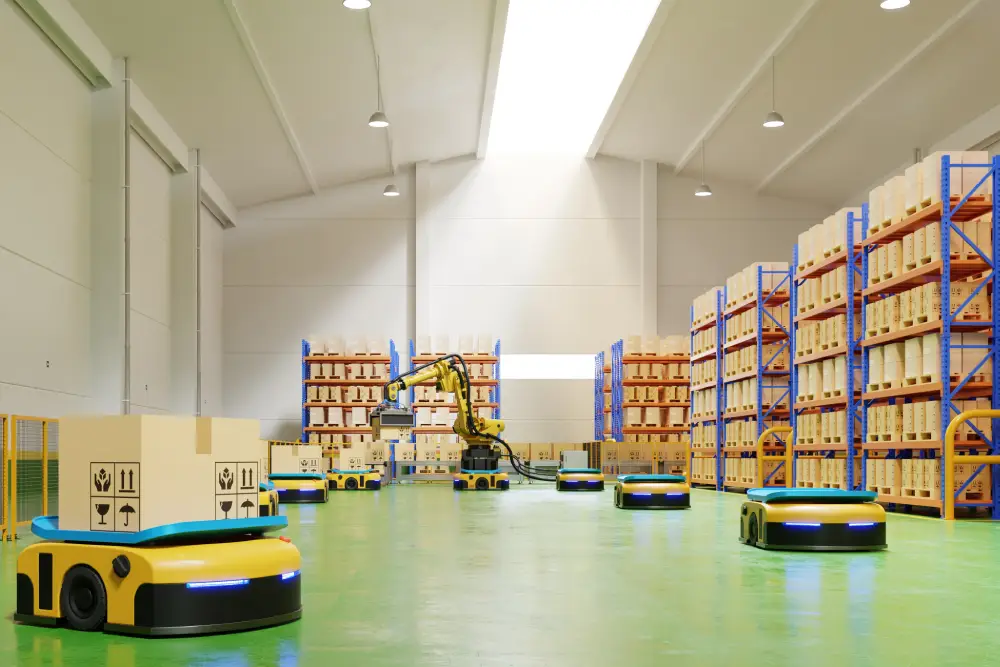
An AGV is a mobile robot that follows a defined path or map to transport materials inside a factory. It carries pallets, parts, sub-assemblies, or finished goods between fixed pickup and drop-off points.
AGVs do three things humans do not do well. They repeat the same task without fatigue. They run at night without overtime pay. And they avoid collisions on a predictable schedule.
How an AGV Differs from a Manual Forklift in a Manufacturing Plant
A manual forklift needs a trained operator and breaks for every shift change. Human error causes about 95% of forklift accidents. An AGV runs on a battery, follows a programmed route, and stops automatically when sensors detect an obstacle. Cost per ton-mile drops 40–60% over a 5-year period.
How an AGV Differs from an AMR (Autonomous Mobile Robot)
AGVs follow fixed paths set by tape, wires, or pre-mapped points. AMRs use AI and SLAM to navigate freely and re-route around obstacles in real time.
AGVs cost less, behave more predictably, and have a longer track record in heavy industry. AMRs offer more flexibility but cost 30–50% more and need stronger IT infrastructure. Most modern factories run both.
Where AGVs Sit in the Industry 4.0 Stack
AGVs are the physical layer of Industry 4.0 material handling. They connect to the MES (Manufacturing Execution System), WMS (Warehouse Management System), and PLC (Programmable Logic Controller) layers through wireless protocols. Data flows both ways. AGVs report status. The central system assigns tasks.
How an AGV Works: Components and Working Principle
An AGV is a self-contained robot. Strip it down and you find five subsystems, all working together to move a payload from A to B.
The Five Core Components Inside Every AGV
- Drive system — electric motors and wheels (differential drive, omnidirectional, or steered)
- Navigation sensors — laser scanners, cameras, magnetic sensors, or LiDAR
- Safety system — bumpers, emergency stops, area scanners (PLd or SIL2 rated)
- Battery and power management — lithium-ion (mostly LiFePO4), 8–16 hour runtime
- Controller and communication module — onboard CPU, Wi-Fi or 5G radio
How AGVs Communicate with the Factory Control System
Each AGV reports its location, battery level, and task status every 100–500 milliseconds. A fleet manager—software running on a server—assigns new jobs based on priority, distance, and battery state. Communication uses Wi-Fi 6, 5G, or in some plants, private LTE.
How Battery and Charging Systems Power an AGV
Most modern AGVs use opportunity charging. The AGV docks at a charging station between tasks for 5–15 minutes at a time. This removes the dead time of full discharge-recharge cycles. Battery life: 5–8 years before replacement.
What Types of AGVs Are Used in Manufacturing?
Manufacturers use five main AGV types. Each fits a different payload and workflow.
Tugger AGVs for High-Volume Line-Side Replenishment
A tugger AGV pulls a train of carts behind it. It is best for delivering parts to multiple assembly stations on one trip. Typical payload: 1,000–10,000 kg (2,200–22,000 lbs) towed. Common in automotive assembly.
Unit Load AGVs for Pallet and Container Transport
A unit load AGV carries one large item—usually a pallet, container, or roll cage—on its back. Payload: 500–3,000 kg (1,100–6,600 lbs). Used in warehousing and finished goods movement.
Forklift AGVs for Rack-Level Storage and Retrieval
A forklift AGV is exactly what it sounds like: a driverless forklift. It picks up and places pallets at floor level or on racks up to 12 m (40 ft) high. Payload: 1,000–3,500 kg (2,200–7,700 lbs).
Assembly Line AGVs for Just-in-Sequence Production
These AGVs move sub-assemblies between stations on an assembly line. They sync with takt time—the production beat—and stop precisely at each station. Common in car body shops and electronics assembly.
Heavy-Duty AGVs for Automotive and Aerospace Frames
Heavy-duty AGVs carry entire car bodies, truck frames, or aircraft components. Payload: 5,000–80,000 kg (11,000–176,000 lbs). They use special wheels, custom decks, and often run in pairs.
How AGVs Navigate Inside a Manufacturing Facility
Navigation is the brain of an AGV. Six methods dominate the market.
Magnetic Tape Navigation: Lowest Cost, Lowest Flexibility
The AGV follows magnetic tape stuck to the floor. Cheap to install at $5–$20 per meter. Simple to maintain. But changing the route means peeling up tape and re-laying it. Best for fixed, repetitive paths in light-duty plants.
Wire-Guided Navigation: Durable but Hard to Reroute
A wire embedded in a floor slot emits a low-frequency signal. The AGV follows the signal. The wire lasts 15–20 years. But reconfiguring the route means cutting concrete.
Laser-Guided Navigation: Sub-Centimeter Accuracy
Reflectors are mounted around the facility at fixed heights. A rotating laser on the AGV measures angles to multiple reflectors and calculates position. Accuracy: ±5 mm. Used in cleanrooms and precision assembly.
Vision-Based Navigation: Adaptive but Light-Sensitive
Cameras read floor markings, QR codes, or natural features. Vision AGVs cost less than laser systems. Routes change through software. Downside: bright sun, glare, or low light disrupts performance.
Natural Feature Navigation (SLAM): The Industry 4.0 Standard
SLAM stands for Simultaneous Localization and Mapping. The AGV builds and updates a map of the factory using LiDAR or 3D cameras. No tape, no wires, no reflectors. Routes change with a software update. This is the dominant choice for new installations.
LiDAR + IMU Fusion: The Newest Generation
The latest systems fuse LiDAR with an Inertial Measurement Unit (IMU). The IMU tracks motion during sensor blind spots. Recent research shows fusion reduces navigation drift by 11–12% versus standalone LiDAR. This is the navigation backbone of the next wave of smart-factory AGVs.
What Manufacturing Tasks Do AGVs Perform?
AGVs perform five recurring tasks across most factories.
Raw Material Movement from Receiving to Production
AGVs collect raw stock—steel coils, plastic resin, paper rolls—from the receiving dock and deliver it to staging zones near production lines.
Work-in-Process (WIP) Transport Between Workstations
WIP transport is the oldest AGV application. Parts move from stamping to welding to paint, station by station, on a tight schedule. AGVs replace conveyors that cannot change route.
Finished Goods Movement to Storage and Shipping
After packing, AGVs move finished goods from the line to high-density storage or the shipping dock. Damage rates drop sharply versus manual forklifts.
Tool and Die Delivery in Heavy Manufacturing
Stamping plants and metal forging operations use heavy-duty AGVs to swap tools and dies that weigh 5–20 tons. This cuts changeover time by 30–50%.
Cross-Floor Transport via Industrial Elevators
Multi-floor factories use AGVs that enter and exit industrial freight elevators to move goods between levels. The AGV requests the elevator, drives in, and exits at the destination floor. This unlocks the same automation benefits across a multi-story plant. We cover the engineering details in Section 8.
Why Manufacturers Choose AGVs Over Manual Material Handling
Manufacturers do not buy AGVs for technology’s sake. They buy for measurable returns.
How AGVs Reduce Labor Cost by 30–50% in Repetitive Transport
One AGV replaces 1.5 to 2 full-time forklift operators across three shifts. Annual labor savings: USD 80,000–150,000 per AGV in North American and European plants.
How AGVs Improve Workplace Safety and Reduce Forklift Accidents
OSHA reports about 85 forklift fatalities and 35,000 serious injuries per year in the U.S. alone. AGVs remove the human error behind most of these. The AGV stops within 100–300 ms when a person enters its safety zone.
How AGVs Increase Throughput in Continuous-Flow Manufacturing
Manual handling has gaps—breaks, missed calls, miscommunication. AGVs do not. In auto assembly plants, AGV-driven WIP transport increases line throughput by 8–15%.
How AGVs Enable 24/7 Lights-Out Production
AGVs run nights, weekends, and holidays without overtime or supervision. A lights-out shift recovers 60–70% more capacity from the same plant footprint.
How AGVs Improve Inventory Accuracy and Traceability
Every AGV move is logged automatically—origin, destination, time, payload ID. Inventory accuracy reaches 99.5%+ versus 92–95% in manual environments. This pays back during audits, recalls, and ERP reconciliation.
Which Industries Use AGVs Most Heavily?
AGV adoption is uneven. Five industries lead.
Automotive Manufacturing: The Largest AGV Adopter
Automotive accounts for about 35% of global AGV installations. Every car plant uses AGVs for body, engine, and seat delivery. Major OEMs run fleets of 200+ AGVs per plant.
Electronics and Semiconductor Cleanrooms
Cleanrooms cannot tolerate operator-introduced contamination. AGVs use ISO Class 5–8 compatible designs—no shedding, smooth surfaces, HEPA-friendly motion profiles.
Food and Beverage Processing
AGVs move ingredients, finished products, and packaging in temperatures from −25°C to +40°C. Stainless steel construction and washdown ratings are standard.
Pharmaceutical Manufacturing
GMP-compliant AGVs move materials between cleanrooms and warehouses with full audit trails. They reduce contamination risk and human entry into critical zones.
Heavy Machinery and Aerospace Assembly
Aircraft and turbine plants use heavy-duty AGVs to move fuselage sections and engine cores—loads no forklift can safely handle. JoyLive serves manufacturers in all five sectors through our industrial vertical transport solutions.
How Do AGVs Integrate with Industrial Elevators for Multi-Floor Smart Factories?
Most online guides stop at the single-floor warehouse. Real factories often have 3–5 floors. Without elevator integration, AGV automation breaks at the staircase. Here is how to solve it.
Why Multi-Floor Factories Need AGV-Elevator Coordination
Land cost forces modern factories upward. A 4-floor electronics plant in Shenzhen or a 3-floor pharma facility in Singapore needs goods to flow between levels without manual hand-off. The bottleneck is the elevator. If the AGV cannot operate the elevator, you lose 60–80% of the automation benefit.
Communication Protocols Between AGV Fleet Managers and Elevator Controllers
Three protocols dominate AGV-to-elevator communication:
- OPC UA — modern, secure, vendor-neutral. The Industry 4.0 standard.
- Modbus TCP — older, simpler, widely supported by legacy PLCs.
- RESTful API — used by newer cloud-connected elevator controllers.
A well-designed elevator exposes a few key commands: call elevator, set destination floor, hold door, release door, report status. The AGV fleet manager calls these commands as part of a task.
Engineering Requirements for AGV-Compatible Freight Elevators
Not every freight elevator can host an AGV. Key requirements:
- Leveling accuracy ≤ 3 mm at every floor (AGVs cannot climb gaps)
- Cabin floor strength to handle the AGV’s wheel point loads, not just static weight
- Door timing control that the AGV fleet manager can override
- Two-way communication between AGV and elevator controller
- Backup safety—if the AGV stalls, the elevator must not move
- Cabin sensors to verify the AGV is fully inside and centered before motion
These specifications are explained in detail in our companion guide: The Ultimate Guide to Freight Elevators.
Real-World Example: AGV + Smart Industrial Elevator Workflow
A typical AGV-elevator cycle takes 90–150 seconds floor-to-floor:
- AGV reaches the elevator landing and calls the cab via OPC UA
- Elevator confirms availability and arrives, door opens
- AGV enters, sensors confirm full insertion, AGV reports “loaded”
- Elevator closes door and travels to the destination floor
- Door opens, AGV exits, reports “delivered” to the fleet manager
- Elevator returns to its parked floor or accepts the next call
JoyLive’s building digital smart products integrate this workflow at the controller level. No custom middleware required.
How to Implement AGVs in a Manufacturing Plant: A 7-Step Roadmap
Most AGV failures trace back to skipped steps in this roadmap.
Step 1: Map Material Flow and Identify Repetitive Routes
Walk the floor. Mark every movement that happens more than 20 times per day. These are AGV candidates.
Step 2: Choose AGV Type Based on Payload and Cycle Time
Tugger for many small loads. Unit load for pallets. Forklift for racks. Heavy-duty for vehicles or frames.
Step 3: Select Navigation Technology for Your Floor Plan
Fixed routes, light traffic → magnetic tape. Mixed traffic, frequent layout changes → SLAM or LiDAR fusion. Cleanrooms → laser-guided.
Step 4: Plan Charging Stations and Fleet Size
One charging station per 3–5 AGVs. Place stations near low-traffic zones. Fleet size: total task time ÷ available cycle time × 1.2 safety margin.
Step 5: Integrate with MES, WMS, and Elevator Control
This step is where projects stall. Confirm the elevator vendor supports the same protocol your AGV vendor uses. JoyLive freight elevators ship with OPC UA, Modbus TCP, and REST API support to avoid this issue.
Step 6: Run a Pilot Cell Before Full Deployment
Start with 2–3 AGVs on one production cell or one floor. Run 30 days. Measure throughput, downtime, and operator response. Adjust before scaling.
Step 7: Train Operators and Establish Safety Zones
Mark AGV paths on the floor. Train every operator on safety zones, manual override, and emergency stop. ANSI/ITSDF B56.5 is the applicable safety standard in North America.
What Is the ROI of AGVs in Manufacturing?
AGV economics depend on payload, cycle time, and labor cost.
Typical AGV Cost Range by Type and Capability
| AGV Type | Unit Cost (USD) |
| Light-duty tugger | $40,000–$80,000 |
| Unit load AGV | $60,000–$120,000 |
| Forklift AGV | $80,000–$180,000 |
| Heavy-duty AGV | $150,000–$500,000+ |
System integration and software add 20–40% on top of unit cost.
Payback Period Calculation: 18–36 Months for Most Projects
Take annual labor savings. Add throughput gains. Subtract maintenance and energy. Divide total project cost by net annual benefit. Most plants land between 18 and 36 months.
Hidden Costs: Infrastructure, Integration, and Training
Plan for floor preparation, Wi-Fi or 5G upgrades, MES integration, and operator training. These add 15–25% to the headline AGV cost.
How to Justify AGV Investment to the CFO
Three numbers convince finance teams: payback period under 3 years, labor cost reduction, and a measurable safety improvement (insurance savings). Lead with these. Save the technology details for the engineering meeting.
What Are the Limitations and Common Mistakes with AGVs?
AGVs are not the right answer for every workflow.
When an AGV Is the Wrong Choice (and an AMR Is Better)
If routes change weekly, if obstacles are unpredictable, or if the plant runs many small jobs, an AMR fits better. AGVs need stable, repeatable flows.
The Most Common AGV Implementation Mistakes
- Buying before mapping the workflow
- Choosing the wrong navigation type for the environment
- Underestimating Wi-Fi coverage and signal reliability
- Skipping the pilot phase
- Forgetting to integrate with elevators, MES, and WMS
How AGVs Handle Mixed Manual–Automated Environments
Modern AGVs share floor space with human workers, manual forklifts, and other AGVs. Safety scanners, audible warnings, and clear floor marking are essential. Aim for 1.5 m (5 ft) of clearance around AGV paths.
What Is the Future of AGVs in Manufacturing?
The next 5 years will reshape AGV technology in three ways.
AI-Driven Fleet Optimization and Predictive Routing
Fleet managers will use machine learning to predict congestion and re-route AGVs before bottlenecks form. Throughput gains of 10–20% are realistic.
AGV-Robot Arm Hybrid Workstations
A robot arm mounted on an AGV becomes a mobile manipulator. It can pick, transport, and place—replacing 3–4 fixed stations.
Convergence of AGVs, AMRs, and Industrial Elevators in the Smart Factory
The clearest trend: horizontal automation (AGVs, AMRs) and vertical automation (industrial elevators) are merging into one logistics system, governed by one control layer. JoyLive’s building digital smart products are built for this convergence.
Frequently Asked Questions About AGVs in Manufacturing
What is the difference between an AGV and an AMR?
An AGV follows fixed paths set by tape, wires, or pre-mapped points. An AMR uses AI and SLAM to navigate freely and avoid obstacles in real time. AGVs are cheaper and more predictable. AMRs are more flexible.
How much does an AGV cost in 2026?
Unit cost ranges from $40,000 for a light tugger to $500,000+ for a heavy-duty model. Add 20–40% for integration and software.
Can AGVs operate alongside human workers safely?
Yes. AGVs use safety scanners rated to PLd or SIL2 standards. They stop within 100–300 ms when a person enters the safety zone.
How long does it take to deploy AGVs in a factory?
A pilot cell takes 8–12 weeks. Full plant deployment takes 6–18 months depending on fleet size and integration scope.
Do AGVs work in multi-floor manufacturing plants?
Yes—if the elevators support AGV communication protocols and meet leveling, door timing, and safety requirements. JoyLive’s AGV-ready freight elevators are designed for this use.
What is the lifespan of an industrial AGV?
A well-maintained AGV lasts 10–15 years. Battery replacement happens at year 5–8. Software updates and sensor upgrades extend service life.
Can AGVs be retrofitted into an existing factory?
Yes. SLAM and LiDAR-fusion AGVs do not need floor modifications. The harder retrofit is the elevator integration—plan that early.
Talk to a JoyLive Engineer
The three decisions that shape an AGV project: navigation type, fleet size, and elevator integration. Get those right, and the rest follows.
JoyLive Elevator works with global manufacturers to deliver AGV-ready freight elevators and smart factory transport systems. Our engineering team can scope your project and quote within 48 hours.
Request a project consultation | Explore industrial elevator solutions
Want to Know More About Our Products?
View All Products Now