The Ultimate Guide to Freight Elevators: Types, Dimensions, Loading Classes, Cost & How to Choose (2026)
Jump to section
A freight elevator is a purpose-built equipment that moves heavy goods, pallets, vehicles, and machinery between floors. Choose the wrong unit, and your facility pays in downtime, damaged inventory, and code violations.
This guide covers the main types of freight elevators, ASME loading classes, standard dimensions and capacities, real cost ranges, and a practical checklist for selection. The principles apply whether you run a warehouse in Texas, a factory in Vietnam, or a hospital in Saudi Arabia.
JoyLive Elevator has manufactured custom freight solutions for global buyers since 2002. The figures below come from real projects across more than 60 countries.
1. What Is a Freight Elevator?
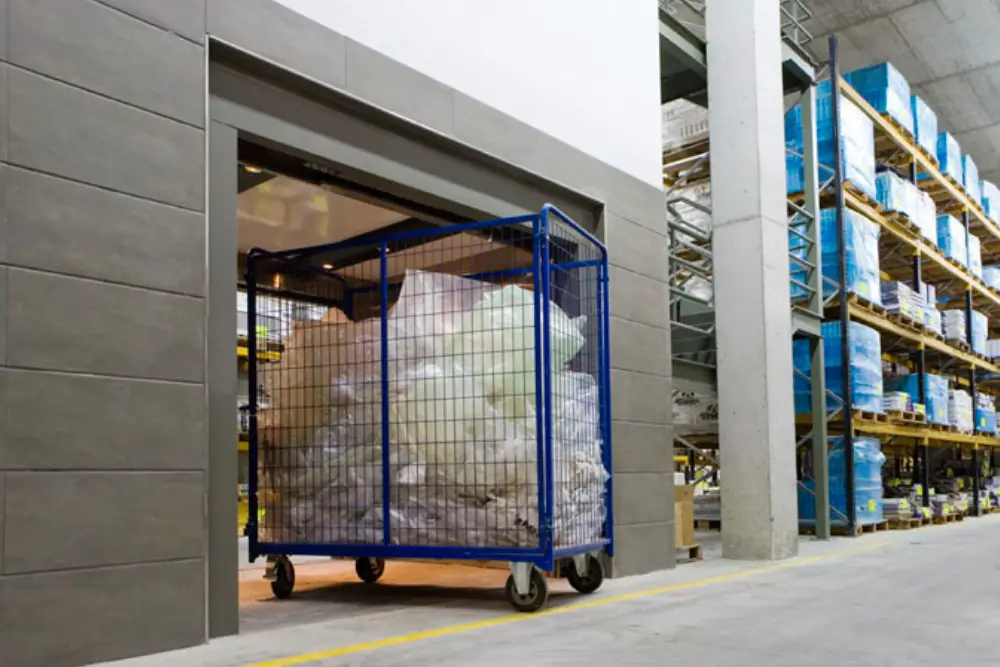
A freight elevator is a vertical transport system designed to carry goods, materials, and equipment between floors. It is built for weight, not for comfort. Steel walls, reinforced floors, and heavy-duty doors are standard.
Most freight elevators carry between 2,000 and 20,000 lbs (900 to 9,000 kg). Heavy-duty units handle 50,000 lbs (22,700 kg) or more. Travel speeds run 50 to 200 feet per minute (0.25 to 1.0 m/s). Cargo does not need to feel comfortable, and slower speeds reduce structural stress.
Freight Elevator vs. Passenger Elevator vs. Service Elevator
These three terms get confused often. They are not the same.
| Feature | Passenger Elevator | Service Elevator | Freight Elevator |
| Primary purpose | People | People + light goods | Goods only |
| Load capacity | 1,000–5,000 lbs | 2,500–6,000 lbs | 2,000–100,000+ lbs |
| Interior finish | Aesthetic | Functional | Steel, utilitarian |
| Door type | Horizontal slide | Horizontal slide | Vertical bi-parting (common) |
| Speed | 150–2,000 fpm | 150–500 fpm | 50–200 fpm |
A service elevator is a passenger elevator with a tougher cabin. A freight elevator is a different machine, engineered from the ground up to take a beating.
2. Types of Freight Elevators
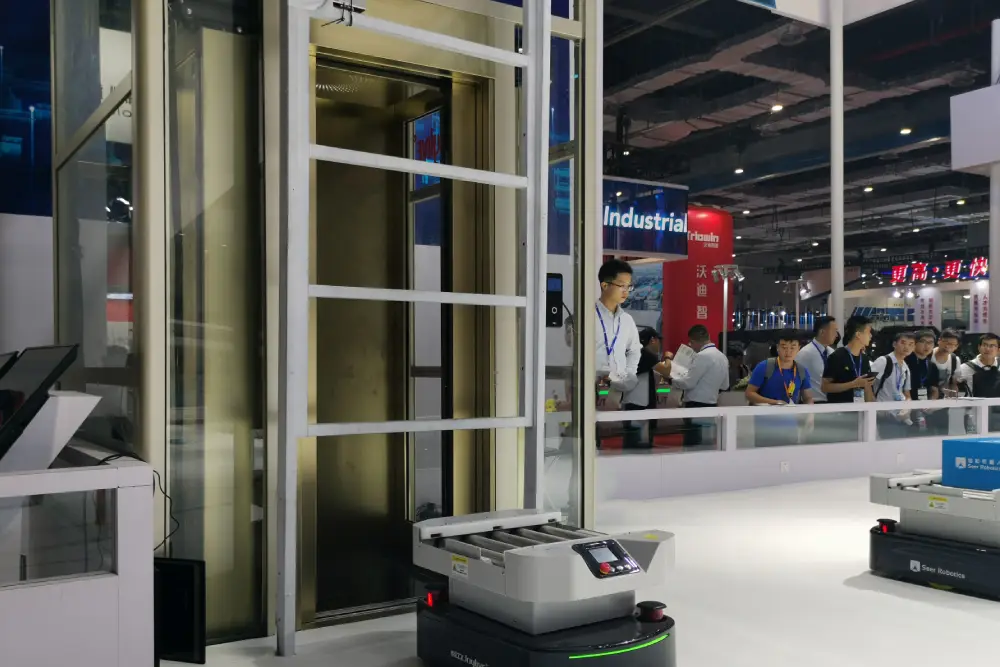
Freight elevators are classified two ways: by drive system, and by application.
2.1 By Drive System
Hydraulic Freight Elevator. A pump pushes hydraulic fluid into a cylinder, which lifts the cab. Hydraulic units handle high loads at low cost. They suit low- and mid-rise buildings—typically up to 6 floors or 60 feet (18 m) of travel. Pros: lower installation cost, simple maintenance, very high capacity. Cons: slower, less energy-efficient, needs a machine room or remote pump unit.
Traction Freight Elevator. Steel ropes connect the cab to a counterweight. An electric motor turns a sheave to move both. Traction units work for any building height and use less energy. They are the standard for buildings over 6 floors, distribution centers, and large industrial sites. Pros: faster, energy-efficient, longer travel. Cons: higher upfront cost, machine room often required.
Machine Room-Less (MRL) Freight Elevator. A traction system with the motor and controls inside the shaft. No separate machine room is needed. MRL designs save building space and lower civil construction cost. They are common in modern industrial projects where rooftop space is limited.
Vertical Reciprocating Conveyor (VRC) / Material Lift. A VRC moves goods only. People may not ride. Because VRCs fall under ASME B20.1—machinery code, not elevator code—installation is faster and code requirements are less strict. VRCs are cost-effective for two-level transfers, mezzanines, and warehouse picks. They cannot replace a true freight elevator in multi-floor operations.
2.2 Drive System Comparison
| Type | Capacity | Travel Height | Speed | Cost Range (Unit Only) |
| Hydraulic | Up to 20,000 lbs (9,000 kg) | Up to 60 ft (18 m) | 50–150 fpm | $20K–$50K |
| Traction | Up to 100,000+ lbs (45,000+ kg) | No practical limit | 100–500 fpm | $60K–$150K+ |
| MRL Traction | Up to 10,000 lbs (4,500 kg) | Up to 200 ft (60 m) | 100–250 fpm | $50K–$120K |
| VRC | Up to 50,000 lbs (22,700 kg) | Typically 2–4 levels | 20–50 fpm | $10K–$40K |
2.3 By Application
Freight elevators also vary by what they carry:
- General Freight — pallets, boxes, equipment
- Vehicle-Carrying — cars, vans, trucks (showrooms, parking)
- Clean Room — pharmaceutical and semiconductor plants
- Explosion-Proof — chemical plants, mines, oil and gas facilities
- Hospital Freight — stretcher beds, medical waste, large equipment
Each application has its own design rules. JoyLive’s freight elevator product line covers all five categories.
3. ASME Freight Elevator Loading Classes
In the United States, freight elevators are governed by ASME A17.1—the Safety Code for Elevators and Escalators. This code defines five loading classes based on how the elevator is loaded and what type of cargo it carries. Choosing the wrong class is a common—and expensive—mistake.
Class A: General Freight Loading
The most common class. Loads are placed manually or with a hand truck. No single piece may exceed 25% of the rated capacity. Suitable for retail backrooms, office buildings, and light warehouses.
Class B: Motor Vehicle Loading
Used in parking structures, car showrooms, and auto-service buildings. The elevator carries vehicles up to its rated capacity. The cabin is sized for vehicle width and length, with wheel guides.
Class C1: Industrial Truck Loading — Truck Rides with Elevator
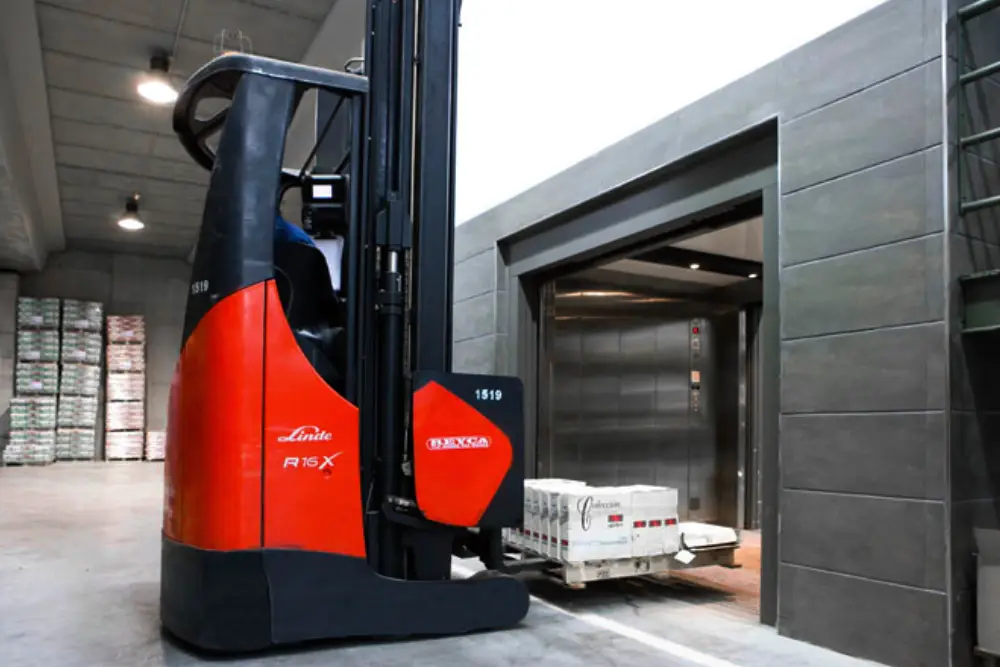
A forklift drives onto the cab and rides up with the load. Combined weight of forklift plus cargo must not exceed rated capacity. The cabin and platform need heavy reinforcement. Common in distribution centers and large factories.
Class C2: Industrial Truck Loading — Truck Loads at Landing Only
A forklift loads cargo onto the cab, then backs off before the elevator moves. During loading, the platform may experience momentary loads up to 150% of rated capacity. Once the truck leaves, rated capacity applies. C2 is structurally one of the most demanding classes.
Class C3: Concentrated Loading
Used for heavy, concentrated loads—dies, machinery, equipment—placed by crane, hoist, or roller. Static load during loading must not exceed rated capacity. The platform is engineered for the specific point load expected.
Quick Reference
| Class | Loading Method | Truck on Cab? | Typical Use |
| A | Manual / hand truck | No | Offices, retail, light warehouses |
| B | Drive-on vehicle | Vehicle only | Parking, showrooms |
| C1 | Forklift | Yes | Distribution centers, factories |
| C2 | Forklift loads, exits | No | Retail distribution |
| C3 | Crane, hoist, manual | No | Heavy manufacturing |
In Europe, the equivalent standards are EN 81-31 for goods-only lifts and EN 81-20/50 for general elevators. In China, GB 7588aligns closely with EN 81. For global projects, verify which code applies before specifying any class.
4. Freight Elevator Dimensions & Capacity
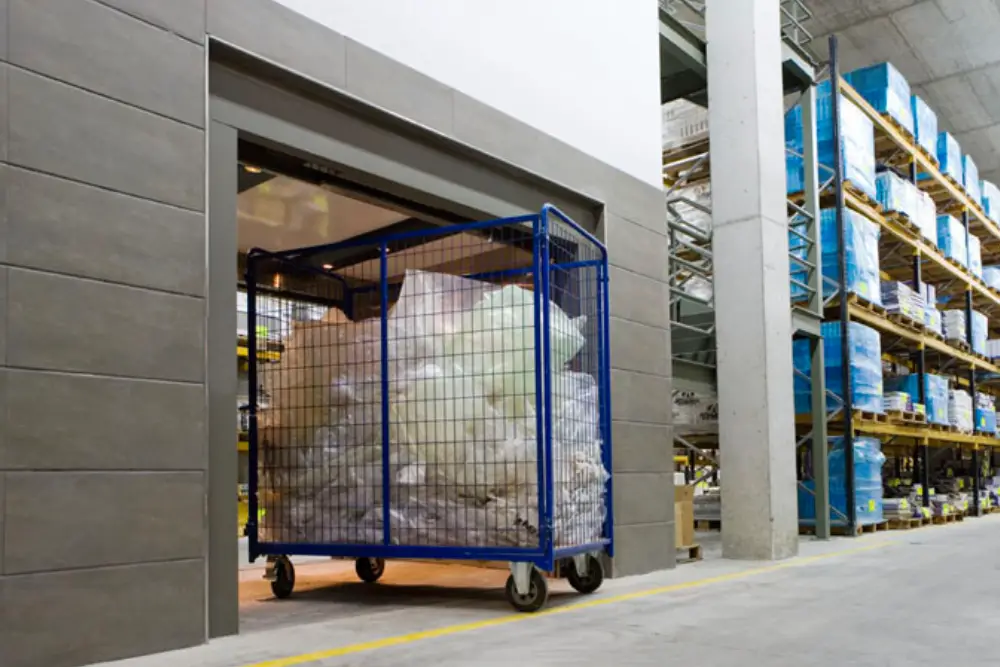
Dimensions and capacity drive everything—cabin size, shaft footprint, civil work, and final cost. Get these wrong and you cannot fit your largest pallet, or you overspend on capacity you never use.
4.1 Cabin Dimensions
Standard freight cabin sizes follow common pallet and forklift footprints.
| Capacity | Cabin Width | Cabin Depth | Cabin Height |
| 2,000 lbs (900 kg) | 5 ft (1.5 m) | 7 ft (2.1 m) | 8 ft (2.4 m) |
| 5,000 lbs (2,300 kg) | 6 ft (1.8 m) | 8 ft (2.4 m) | 8 ft (2.4 m) |
| 10,000 lbs (4,500 kg) | 8 ft (2.4 m) | 10 ft (3.0 m) | 8–10 ft (2.4–3.0 m) |
| 20,000 lbs (9,000 kg) | 10 ft (3.0 m) | 12 ft (3.6 m) | 10 ft (3.0 m) |
| 50,000+ lbs (22,700+ kg) | Custom | Custom | Custom |
Size the cabin to the largest object plus loading equipment. If a 4 ft × 4 ft pallet enters with a 5 ft forklift, you need at least 9 ft of clear depth plus turn-around space.
4.2 Door Opening
Freight elevator doors come in three formats:
- Vertical bi-parting (most common): the door splits horizontally. Top half goes up, bottom half goes down. Maximum opening width, no side intrusion.
- Two-speed horizontal sliding: two panels slide sideways. Used when ceiling height is limited.
- Single horizontal slide: lowest cost, narrower openings.
Door widths range from 4 to 10 ft (1.2 to 3 m). Heights from 7 to 10 ft (2.1 to 3 m). The opening must accept the largest object plus any handling equipment.
4.3 Shaft, Pit, and Overhead
The shaft is always larger than the cabin. Typical clearance: cabin width plus 12 to 24 inches on each side for guide rails, counterweight, and safety gear.
| Component | Hydraulic | Traction |
| Pit depth | 4–8 ft (1.2–2.4 m) | 5–12 ft (1.5–3.6 m) |
| Overhead | 12–14 ft (3.6–4.2 m) | 14–20 ft (4.2–6.0 m) |
| Machine room | Optional / remote | Required (unless MRL) |
4.4 How to Calculate Required Capacity
Start with the heaviest single object you will move. Add the weight of any pallet, container, and handling equipment. Apply a 25% safety margin. The result is your minimum rated capacity.
Example: a 6,000 lb (2,700 kg) machine plus a 1,500 lb (680 kg) forklift, plus 25% margin = 9,375 lbs. Round up to a 10,000 lb (4,500 kg) unit.
5. How Much Does a Freight Elevator Cost?
Pricing varies widely. Type, capacity, travel height, customization, and site conditions all matter. Below are realistic 2026 price bands for a complete installed unit.
Equipment Cost (Unit Only)
| Type | Price Range (USD) |
| Small hydraulic (2,000–5,000 lbs) | $20,000–$50,000 |
| Standard hydraulic (5,000–10,000 lbs) | $40,000–$80,000 |
| Traction freight (10,000–20,000 lbs) | $60,000–$150,000 |
| Heavy-duty traction (20,000+ lbs) | $120,000–$300,000+ |
| VRC / material lift | $10,000–$40,000 |
Installation Cost
Installation adds another $10,000 to $40,000 depending on project complexity. Civil work—shaft construction, pit excavation, structural reinforcement—can add $20,000 to $80,000 if the building does not already accommodate the elevator.
Six Factors That Move the Price
- Capacity and platform size — every 1,000 lbs of added capacity raises cost.
- Travel height and number of stops — each additional stop adds $3,000–$8,000.
- Drive type — traction costs more upfront, less to operate long-term.
- Customization — special finishes, doors, control systems, OEM branding.
- Code compliance — ASME, EN, GB, or local AHJ requirements.
- Region — labor and permit costs vary by country and city.
Total Cost of Ownership
A 20-year TCO calculation often shows traction units cost less than hydraulic, despite a higher upfront price. Energy use, oil replacement, and maintenance frequency favor traction over time.
Annual maintenance contracts typically run $2,000–$10,000. Major component replacement (motor, controls, cables) happens at year 15–20 and costs $15,000–$50,000.
6. Industries & Applications
Freight elevators are infrastructure—as critical as forklifts or loading docks. The right specification depends on the industry.
- Warehouses & Distribution Centers. High-frequency use, often Class C1 with forklifts. Capacity 5,000–20,000 lbs. Smooth, fast loading is essential.
- Manufacturing & Heavy Industry. Class C3 for machinery and dies. Reinforced cabins, high capacity, sometimes explosion-proof variants.
- Hospitals. Stretcher beds, mortuary, food service, medical waste. Antibacterial cabins, smooth ride quality, redundant safety systems.
- Hotels & Mixed-Use Buildings. Service elevators handle most needs, but kitchens and laundry often require true freight units.
- Retail & Shopping Centers. Class A or C2. Inventory restocking, often during off-hours.
- Parking Structures. Class B for vehicles. Reliability matters more than speed.
- Cold Storage. Specialized seals, anti-corrosion finishes, low-temperature lubricants.
- Cleanrooms (Pharma, Semiconductor). ISO Class 5–8 compliant cabins, HEPA-filtered air, smooth surfaces.
JoyLive’s industries page outlines reference projects in each sector.
7. How to Choose the Right Freight Elevator: A Buyer’s Checklist
Most procurement failures trace back to skipped steps in this checklist. Run through all seven before you request a quote.
Step 1: Define Maximum and Average Load
Identify the heaviest object you will move, including all packaging and handling equipment. Then estimate your average load. Size capacity for the maximum, but plan duty cycle and speed around the average.
Step 2: Calculate Travel Distance and Stops
Count floors served. Measure floor-to-floor heights. Total travel determines drive type—hydraulic for under 60 ft, traction for higher.
Step 3: Identify the Loading Method
Manual, hand truck, forklift, pallet jack, or crane? This determines your ASME loading class. Do not let the supplier decide for you—you live with the consequences.
Step 4: Determine the ASME Class
Match your loading method to a class:
- Manual or hand truck → Class A
- Vehicles only → Class B
- Forklift on cab → Class C1
- Forklift at landing only → Class C2
- Concentrated heavy loads → Class C3
When in doubt, specify one class higher than current need. Operations evolve; structures do not.
Step 5: Match Drive System to Building Height
- Up to 4 stops, low traffic → hydraulic
- 4–10 stops, moderate traffic → traction or MRL
- 10+ stops, high traffic → traction with high-efficiency motor
Step 6: Evaluate Customization Requirements
Standard elevators fit standard applications. Most industrial projects need at least one custom element—cabin size, door type, control interface, finish, or branding. Confirm the supplier handles OEM and ODM work in-house.
Step 7: Verify Supplier Credentials
A reliable supplier holds the following at minimum:
- ISO 9001 quality management
- ASME A17.1 compliance for North American shipments
- CE marking and EN 81 compliance for European shipments
- GB 7588 for projects in China and aligned markets
- TÜV or CNAS-accredited safety testing
- Documented project references in your industry
Ask for the most recent certification dates. Lapsed certificates are a red flag.
8. Safety Features & Compliance Standards
A freight elevator without proper safety gear is a workplace hazard, not an asset. Modern units include the following as standard:
- Overload protection — sensors prevent operation if capacity is exceeded
- Emergency stop button — on cab and at every landing
- Door interlocks — elevator cannot move unless all doors are closed
- Safety brakes (governor and safety gear) — stop the cab if it overspeeds
- Buffer system — absorbs energy at the bottom of the pit
- Two-way communication — intercom or phone in the cab
- Backup power — emergency lowering to the nearest landing on power loss
- Phase failure protection — stops operation if electrical supply fails
Compliance Standards by Region
| Region | Primary Standard |
| North America | ASME A17.1 / A17.6, CSA B44 (Canada) |
| Europe | EN 81-20, EN 81-50, EN 81-31 (goods-only) |
| China | GB 7588 (aligned with EN 81) |
| International | ISO 8100 series |
For global projects, request a Declaration of Conformity covering all destination markets. Third-party verification by TÜV, SGS, or CNAScarries more weight than self-certification.
9. Why Custom Freight Elevators Matter
Off-the-shelf freight elevators fit about 60% of real-world projects. The other 40% need customization—because the building is non-standard, the cargo is unusual, or operating conditions are extreme.
When Standard Is Not Enough
- Non-standard shaft dimensions in retrofit projects
- Oversized cargo (industrial equipment, oil pipes, modular building units)
- Harsh environments (chemical exposure, dust, extreme temperatures, humidity)
- Specialized controls (WMS, BMS, or fleet system integration)
- OEM branding for resellers and distributors
What Real Customization Includes
JoyLive’s custom freight elevator program covers:
- Cabin size from 2,000 to 100,000+ lbs capacity
- Door configurations — vertical bi-parting, multi-panel, full-width opening
- Finishes — stainless steel, checker plate, epoxy-coated, antimicrobial
- Drive systems — hydraulic, traction, MRL, with regenerative options
- Special functions — explosion-proof, clean room, marine-grade corrosion protection
- Control systems — touchscreens, multi-language interfaces, IoT remote monitoring
- OEM / ODM — client brand logo and color schemes on the equipment
If you have a non-standard project, send the specifications first. Off-the-shelf catalogs waste everyone’s time when the application is custom.
10. Frequently Asked Questions
What is the difference between a freight elevator and a service elevator?
A service elevator is a passenger elevator with a tougher cabin, used by staff to move both people and light goods. A freight elevator is built only for cargo, with higher capacity and heavier construction.
Can passengers ride in a freight elevator?
Only an authorized operator can ride with the cargo, and only if the elevator is rated for it. Regular passenger transport requires a passenger-rated elevator under ASME A17.1.
Hydraulic or traction freight elevator: which is better?
Hydraulic suits low-rise buildings and high capacity at lower cost. Traction is better for taller buildings, faster speeds, and lower long-term energy use.
How long do freight elevators last?
A well-maintained freight elevator lasts 20–30 years. Major modernization—controls, motors, cables—typically happens at year 15–20.
How long does freight elevator installation take?
A standard project takes 6–12 weeks from delivery to commissioning. Custom or complex projects can run 4–6 months including civil work.
Can I install a freight elevator in an existing building?
Yes, but the building must accommodate the shaft, pit, and overhead clearance. Retrofits are common but cost 20–40% more than new construction installations.
Talk to a JoyLive Engineer
The three decisions that matter most: loading class, drive system, and supplier credentials. Get those right, and the rest follows.
JoyLive Elevator has manufactured freight solutions for global projects since 2002. Our engineering team can scope your project, recommend the right configuration, and quote within 48 hours.
Request a freight elevator quote | Browse freight elevator products
Want to Know More About Our Products?
View All Products Now